
Japan Solar Update: No.177 (Dec 1 ~ 5, 2025)
The Agency for Natural Resources and Energy (ANRE) under The Ministry of Economy, Trade and Industry (METI) held the 105th meeting of the Procurement Price Calculation Committee and started discussion on the price calculation and tender scheme of the FIT and FIP programs in FY 2025.
As for the price calculation, METI presented a policy to evaluate the progress of each power source toward energy independence.
As for utilizing the tender scheme, the committee will discuss the following subjects: 1) whether it continues the current tender scheme and 2) whether it adopts a new approach which the government sets a uniform purchase price/ standard price, instead of the tender scheme.
The committee will also discuss the support for large-scale commercial PV systems from FY 2027 onward as well as the purchase period and price on the initial investment support scheme of residential PV systems.
<Key points>
- As discussion points (draft) on cross-power source, METI presented the approach to support based on progress toward self-sufficiency, the methodology for price calculation under future FIT/FIP programs, and the appropriate use of tender schemes
- Efforts will be made to improve the business environment and achieve cost reductions so that investments in power sources proceed even without FIT/FIP programs
- Regarding the recent rise in cost data, there is a policy to appropriately reflect it in purchase prices/reference prices
- The committee will consider whether to continue the tender scheme or have the government set a uniform price instead of bidding
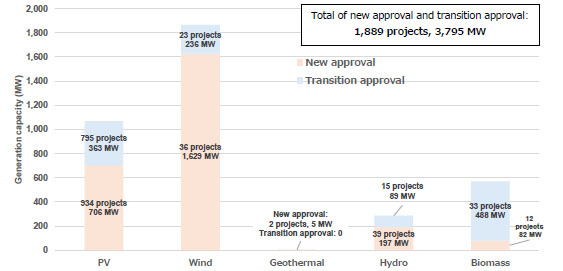
- The utilization of the FIP program will be summarized; as of the end of March 2025, the total number of certifications was 1,889, totaling 3,795 MW
Discussion points (draft) on cross-power source
Approaches to support based on the progress toward self-sufficiency
It is important to improve the business environment for renewable energy so that environmental value is properly evaluated, and to aim for cost reductions to the point where new power-source investment will progress even without the FIT/FIP programs
Approaches to price calculations under the future FIT/FIP program
- While recent cost data have increased due to inflation, uniform and automatic upward adjustments of assumed prices will not be made
- The characteristics of each power source will be considered, and it will be checked whether (i) efforts toward self-sufficiency are being made, and (ii) the increase in cost data occurs even when projects are implemented particularly efficiently
- The policy is to appropriately reflect the increase in cost data in the purchase price/ standard price based on comprehensive judgments
Approaches to utilizing the tender scheme under the FIT/FIP programs
- Even if the number of projects participating in the tender decreases, the maintenance and operational costs of the tender scheme remain at a certain level, which is a challenge
- It is necessary to consider (i) whether to continue the tender scheme, or (ii) whether the government should set a uniform purchase price/ standard price instead of using tenders
Status of use of the FIP program (as of end March 2025)
Compared to the FIP-approved capacity as of the end of March 2024, output capacity has increased 2.2-fold and the number of projects has increased 1.6-fold
Figure 2 Discussion points of cross-generation and the status of use of the FIP program
Source: Materials of the 105th meeting of the Procurement Price Calculation Committee (October 24, 2025), compiled by RTS Corporation