Japan Solar Update: No.181 (Dec 29, 2025, ~ Jan 2, 2026)
One of the major highlights of 2025 in Japan was undoubtedly the Osaka–Kansai Expo, held for the first time in 55 years under the theme “Designing Future Society for Our Lives.” The event showcased a wide range of innovations that offered visitors an immersive experience of future society and sustainable urban living.
The story is also available at RTS YouTube Page
Among the many technologies presented, renewable energy solutions played a central role throughout the venue. Solar-powered installations—ranging from cutting-edge perovskite solar cells to creative reuse of decommissioned panels—were integrated into public spaces, demonstrating how clean energy can support everyday life in a natural and visually seamless way.
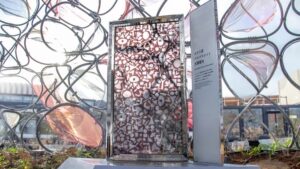

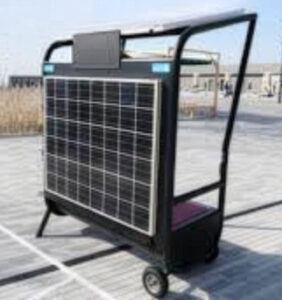
One symbolic example was the “Sorais” solar-powered bench, designed using reused solar panels. The bench provided lighting and device charging while offering visitors a comfortable place to rest, showing how solar energy can blend into urban furniture and contribute to circular design. Cutting-edge perovskite solar cells and the “Sorais” solar-powered bench—made from reused solar panels—were integrated seamlessly into the Expo grounds. “Sorais” repurposes decommissioned modules into a functional public bench that provides lighting and device charging while offering visitors a comfortable place to rest.
Together, these installations symbolized how renewable energy can blend naturally into everyday urban spaces.
A Flagship Example: Perovskite Solar Cells at Yumeshima No.1 Transportation Terminal
To illustrate how these renewable technologies were implemented on-site, one of the most notable examples was the large-scale perovskite solar installation at the Yumeshima No. 1 Transportation Terminal, located just in front of the Expo’s West Gate. This project served as a showcase of next-generation solar technology in action.



Sekisui Chemical Co., Ltd. installed 257 film-type perovskite solar cell modules—each measuring 2 m × 1 m—across roughly 250 meters of the terminal’s 1-kilometer roof. With a target efficiency in the mid-teen range, the system powers 282 ceiling-mounted 100-W LED lights, supported by a large-scale storage battery that ensures up to 14 days of continuous operation, even under cloudy or rainy conditions. This installation was recognized with the “Sustainability Award (Decarbonization Category)” from the Japan Association for the 2025 World Exposition for its innovation and practical contribution to decarbonization efforts.
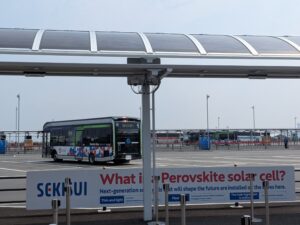

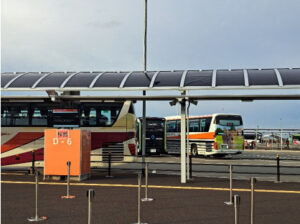
Osaka–Kansai Expo Yumeshima No. 1 Transportation Terminal Solar Power System
〈Location〉 Yumeshima Higashi 1-chome, Konohana-ku, Osaka City, Osaka Prefecture
〈Equipment〉 Solar Cells: 257 film-type perovskite solar cell modules manufactured by Sekisui Chemical Co., Ltd.
〈Start of Operation〉 December 2024
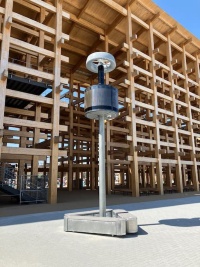
Beyond the transportation terminal, Sekisui Chemical’s perovskite solar cells were also deployed on smart poles with IoT functions, inside the Osaka Healthcare Pavilion, and on kitchen trucks throughout the Expo site. The company aims to commercialize this technology in FY2025, launch a production line with an annual capacity of approximately 100 MW in 2027, and expand to gigawatt-scale manufacturing by 2030.