
In November 2025, the International Energy Agency (IEA) published a report “World Energy Outlook 2025 (WEO2025)” that shows the future outlook for energy. The report identifies PV power generation as playing a pivotal role in the global energy transition, and its adoption is expected to progress rapidly.
According to WEO2025, global electricity demand in 2024 was 2%, well above the long-term average growth rate of 1.4% (2010 to 2023), and most of this growth was covered by PV and wind power. Global electricity demand is expected to continue to increase in the future with increased demand for heating and cooling due to climate change and the increase in data centers for AI, and WEO2025 analyzes that most of the growth in electricity demand will be covered by PV and wind power generation.
In its “Electricity Mid-Year Update 2025” published in July ahead of WEO2025, the IEA predicted that renewable energy would surpass coal-fired power generation as early as 2025 or 2026 at the latest to become the world’s largest power source in terms of total power generation. In fact, in the first half of 2025, global renewable energy generation was reported to have surpassed coal-fired power generation for the first time. According to an analysis by Ember (UK), the power generation from renewable energy in the same period was 5,072 TWh, accounting for 34.3% of the total power generation. On the other hand, coal-fired power generation amounted to 4,896 TWh, accounting for 33.1% of the total power generation. During the same period, global electricity demand increased by 369 TWh, and the increase in demand was fully covered by an increase in PV power generation (306 TWh) and wind power generation (97 TWh). In light of this situation, PV power generation is expected to make a significant contribution to the expansion of energy demand in the future. In WEO2025, the outlook on the introduction of PV power generation is presented based on three scenarios as shown in Table 1.
Table 1 Outlook of cumulative global PV installed capacity in WEO2025 based on three scenarios

Source: World Energy Outlook2025 (WEO2025) (October 2025) by the International Energy Agency (IEA), compiled by RTS Corporation
The WEO2025’s outlook for the introduction of PV systems in the Stated Policies Scenario (STEPS) has been slightly lowered from last year’s WEO2024. This is due to the re-withdrawal of the United States from the Paris Agreement and the increase in the number of countries that are refocusing on nuclear power generation due to decarbonization policies. As shown in Figure 1, the ratio of renewable energy is estimated to increase, and PV power generation will stay in the central part, same as the outlook of the last year.
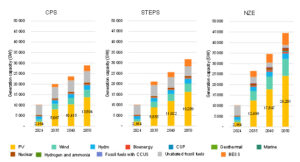
Figure 1 Outlook of power generation capacity by three scenarios by technology
Source: World Energy Outlook2025 (WEO2025) (October 2025) by the International Energy Agency (IEA), compiled by RTS Corporation
In a joint letter released by the IEA, the International Renewable Energy Agency (IRENA) and the European Commission (EC) in September 2025, it was stated that the world is transitioning to clean energy at an unprecedented pace, and in 2024, the investment in clean energy in the power sector reached ten times that of fossil fuels. The background to this lies in climate change as an existential crisis, a shared understanding that energy security is national security, and a shared recognition that clean energy is indispensable for ensuring both security and growth. These factors are accelerating the deployment of renewable energy. In this way, PV power generation is essential in the world to ensure competitiveness over existing power sources for stable energy supply and decarbonization, and its deployment is being expanded as the main power source.
In Japan, the introduction target of 200 GW to 300 GW, which makes PV the largest power source in Japan, has been set as a target for 2040 in the Seventh Strategic Energy Plan, and to achieve this, efforts are being made to overcome social and economic issues that hinder the expansion of the PV deployment, including economic feasibility, variable power supply, grid constraints, location constraints, development in harmony with local communities, establishment of supply chain, zoning suitable and unsuitable areas for the development of renewable energy, as well as handling of used PV modules. In addition to creating an environment for widespread use, Japan must simultaneously work on policy measures to expand the annual PV installed capacity to the 10 GW level through concerted efforts by the public and private sectors, and fundamentally strengthen business development, and shift the emphasis to accelerating the “independence of PV power generation.”