
The Paris Agreement, agreed in December 2015, marked its 10th anniversary in December 2025. In 2015, the annual and cumulative global PV installed capacities were 50.8 GW and 231 GW, respectively. Over the decade after 2015, PV power generation has penetrated across the world, and by 2025, they have grown significantly to approx. 650 GW and approx. 2.8 TW, respectively.
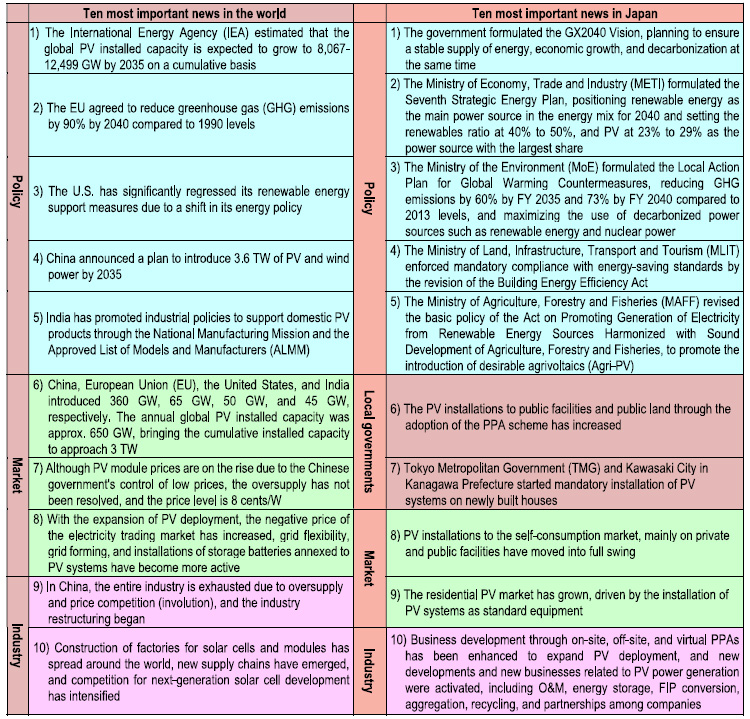
As shown in Table 1, PV power generation experienced various developments and changes in 2025 both domestically and internationally. After taking a break from the previous significant expansion of deployment, it has settled on a steady expansion. In terms of policy, the U.S. has significantly regressed its support for renewable energy due to a shift in its energy policy, while other countries and regions around the world, including Europe, China, and India, are strengthening support to expand PV deployment, and the global trend toward transitioning from fossil fuels to decarbonized power sources is irreversible.
Table 1 Ten most important news related to PV power generation in 2025
@RTS Corporation
In the market, the oversupply of PV modules has continued, but the price decline has been stopped at the level of 8 cents/W. With the expansion of PV deployment, new business opportunities are emerging due to the increase in negative prices in the electricity trading market, as grid flexibility, grid forming, and installation of storage batteries annexed to PV systems are gaining momentum.
In the PV industry, in China, which leads the world’s PV production, the entire industry is exhausted due to excessive competition following oversupply (involution), and while the industry has begun to reorganize and strengthen itself, the construction of solar cell/module factories has spread around the world, and new supply chains have begun to form. In addition to the competitiveness of PV power generation costs, the cost of energy storage is declining, and the advantages of PV systems integrated with energy storage are expected to increase further.
In Japan, the government formulated the GX2040 Vision and set out national goals toward 2040 aimed at securing a stable energy supply, economic growth, and decarbonization at the same time, and decided on the Package of Measures for MW-scale PV Projects to strengthen regulations, strengthen cooperation with local communities, and prioritize support for projects ensuring harmony with local communities.
The Ministry of Economy, Trade and Industry (METI) formulated the Seventh Strategic Energy Plan, positioning PV as the largest power source in the energy mix for 2040, and indicating a policy for future PV deployment with three pillars: 1) rooftop PV systems, 2) ground-mounted PV systems, and 3) social implementation of next-generation solar cells. While initiating initial investment support for rooftop PV systems and a scheme to certify Long-term Stable Qualified PV Power Producers, a business environment has been developed from multiple perspectives toward a full-fledged expansion of PV deployment, including promoting the use of the FIP program, evaluating the value of renewable energy, strengthening support for perovskite solar cells (PSCs), and supporting grid-scale energy storage stations.
The Ministry of the Environment (MoE) formulated the new Plan for Global Warming Countermeasures and will promote the energy transition to decarbonized power sources. In order to expand PV deployment, support for the introduction of PV has been strengthened, including deployment led by local communities, active introduction to public facilities owned by the national and local governments, and support for private companies to promote self-consumption. New efforts to expand the introduction of next-generation solar cells and introduction via the PPA scheme have also begun.
The Ministry of Land, Infrastructure, Transport and Tourism (MLIT) has begun to make it mandatory for all new residential and non-residential buildings to comply with energy-saving standards through the revision of the Building Energy Efficiency Act, and has expanded the introduction of renewable energy to public infrastructure facilities such as railways, roads, and ports following airports. The Ministry of Agriculture, Forestry and Fisheries (MAFF) has revised the basic policy of the Act on Promoting Generation of Electricity from Renewable Energy Sources Harmonized with Sound Development of Agriculture, Forestry and Fisheries and has begun to organize and promote the introduction of desirable Agri-PV systems.
Local governments have promoted the establishment of renewable energy promotion zones and expanded the introduction of PV by adopting the PPA scheme for public facilities and public land. In addition, the Tokyo Metropolitan Government (TMG) and Kawasaki City in Kanagawa Prefecture started mandating new houses to install PV systems.
In the PV market, PPA schemes that are not dependent on FIT and FIP programs have emerged, and the self-consumption market centered on PV installations on buildings and facilities by electricity consumers have emerged. In response to mandatory compliance with energy-saving standards, the residential market is moving toward making PV systems standard equipment and has turned to a growth trajectory.
The PV industry is strengthening its business development by shifting its focus to on-site, off-site, and virtual PPAs while promoting partnerships among companies, and is also actively expanding into new business areas such as O&M, FIP conversion, energy storage, repowering, aggregation, and recycling, which are expected to grow hereafter.
In 2026, measures are expected to be developed in line with the policies of the Seventh Strategic Energy Plan and the Package of Measures for MW-scale PV Projects. The PV industry should work with the government to open the curtain on the expansion of the second phase of PV deployment, paving the way for business independence and full-scale deployment of PV power generation.