
In the February 2026 issue, we, RTS Corporation made a forecast that the cumulative PV installed capacity by 2040 will range from 199 to 277 GW, based on the Seventh Strategic Energy Plan, by adding up the projected installed capacities across market segments.
To expand PV installed capacity toward the 2040 target, not only achieving both the “quality and quantity” of PV as a power source, but also “speed” is required. In making the forecasts on PV installed capacity, it has become clear that the coming five years up to 2030 will be a critical fiveyear period for achieving the 2040 target.
So far, installed capacity has grown with promotional measures and regulatory reforms by the national and local governments, or economic advantages and profitability. To expand installation hereafter, however, it is essential to simultaneously address challenges specific to PV power generation and establish a new environment to promote deployment.
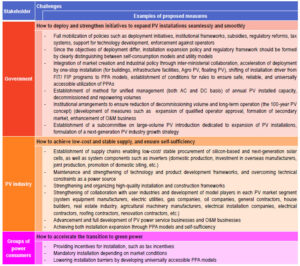
This requires measures addressing deployment-related challenges posed by stakeholders, as well as challenges derived from the inherent features of PV. There are three key challenges related to the stakeholders involved in PV installations as follows: 1) how the government can seamlessly accelerate and smoothly deploy and strengthen the initiatives to expand installation; 2) how the PV industry can take responsibility for low-cost and stable supply and become self-reliant; and 3) how groups of power consumers can accelerate the transition to green power.
Examples of measures to be taken by these three stakeholder groups are proposed and shown in Table 1.
Table 1 Stakeholder-related challenges and examples of and proposed measures for achieving the 2040 target of PV installed capacity
@RTS Corporation
Subsequently, it is also crucial to address the challenges derived from the inherent features of PV for achieving the 2040 target. There are five challenges as follows: 1) how to improve economic efficiency; 2) how to shift away from being a variable power source; 3) to what extent grid constraints can be resolved; 4) how far sites suitable for PV power generation can be expanded while facing location constraints; and 5) how to enhance social acceptance of PV. Proposed measures to address these five challenges are shown in Table 2.
Table 2 Challenges and examples of proposed measures for achieving the 2040 target of PV installed capacity
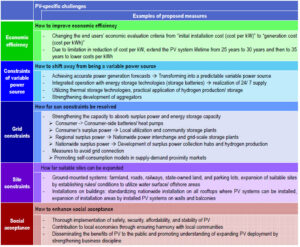
In addition to the stakeholders involved in PV installations, if even one of the measures addressing the PV-specific challenges is missing, future expansion of PV installations will be restricted. However, these challenges are manageable through policy measures, institutional frameworks, and technological development and integration, and overcoming the challenges will lead directly to largescale installations. Over the next crucial five year period leading up to 2030, both the public and private sectors must work together to overcome these various challenges and accelerate the selfsufficiency and deployment of PV.
@RTS Corporation