
Forecasts of PV system prices
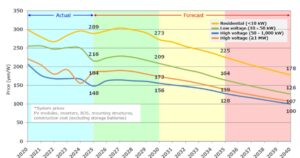
In the RTS Monthly Perspective in the January 2026 issue of this monthly report, we presented the forecasts of PV installed capacity in Japan based on the Seventh Strategic Energy Plan (SEP), and also the forecasts of PV system prices by capacity range, which serve as a premise of the forecasts of PV installed capacity. Figure 1 illustrates the forecasts of PV system prices, which assume the realization of the lower limit 23% of the ratio of PV power generation in the FY 2040 energy mix indicated in the Seventh SEP.
The basic assumption behind the forecasts is that cost reduction will be achieved through mass production and introduction expansion of PV modules and other related equipment, and we analyzed the forecasts, considering PV market trends, technology trends, price competition among PV manufacturers, and social change. It is assumed that PV system prices will remain high (or slightly increase) until around 2027-2028, due to the sharp price rise in silver as an electrode material, and the impact of the abolition of rebates of value-added taxes (VAT) on exports in China.
However, afterward, solar cell prices are expected to decline and thus PV system prices will also be on a declining trend, due to the transition to solar cell technology using less silver, reduction in price per watt through improvement of conversion efficiency, and oversupply of PV modules due to increased production in countries other than China, etc. In 2030, PV system prices are forecasted to decrease by 3 – 6%. The downward trend is expected to continue, and 30-40% decline is forecasted by 2040.
The factors in the rise in system prices, other than solar cells, include the rise in the costs of cybersecurity measures, labor, construction works, and logistics; additional safety measure costs for system structures and fire prevention; and additional costs for projects developed in harmony with local communities. Meanwhile, the factors behind the decline in system prices include cost reduction in equipment procurement through the adoption of inexpensive foreign products, the improved efficiency and substantial shortening of work periods of design and construction through the utilization of IT and AI, the realization of labor-savings and man-hour reduction through standardization and robot technology utilization and streamlined distribution.
Considering these factors behind the increases and decreases in cost, cost reduction is expected to progress in the medium to long term.
@RTS Corporation
Figure 1 Forecasts of PV system prices by capacity range (forecast scenario to realize the lower limit 23% ratio of PV power generation in the FY 2040 energy mix indicated in the Seventh SEP)
Source: “Forecasting PV installed capacity in Japan (2025-2040)” (January 2026, report in Japanese), compiled by RTS Corporation
Forecasts of PV power generation costs (LCOE)
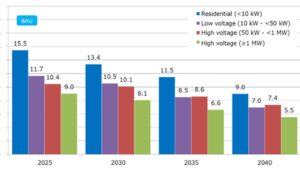
To estimate PV power generation costs (LCOE, kWh/yen), we calculated the total electricity generation during the operation period by adding the estimates of system costs to the estimates of O&M costs and disposal costs of PV systems (a math formula shown in NEDO’s Solar Power Development Strategy (2014) was used for calculation). As shown in Figure 2, LCOE in 2025 were 15.5 yen/kWh (9.73 cents/kWh) for residential applications, which is the highest, and 9.0 yen/kWh (5.65 cents/kWh) for ≥ 1 MW high-voltage facilities, which are lower than retail electricity prices.
Furthermore, in the future, cost reduction is expected to progress due to the extension of the system operation period, O&M cost reduction, and disposal cost reduction in products on the premise of recycling. The system operation period will be extended to approx. 40 years. Therefore, both management and technical skills, such as how installed PV systems should be used carefully in a long-term and stable manner, while operating and maintaining them appropriately, will be required.
From reduction in price per kW to reduction in cost per kWh
Up until now, price reduction in PV power generation has generally referred to reduction in system installation costs (price per kW). However, many overseas-manufactured products are now used as the components of PV systems, and thus reduction in installation costs of equipment itself has become more and more difficult.
From now on, reduction in cost per kWh at PV power plants, or reduction in LCOE as power plants by increasing lifetime electricity generation of PV systems will become important.
The expected lifecycle of a PV module itself, as the main component of PV system, is generally 20 years or more, whereas products with a 40-year output warranty by manufacturers are also emerging. To realize reduction in PV power generation costs, while fully utilizing the characteristics and performance of these long-life products, it will become important to extend their service life through system design and installation, increase in PV power generation through appropriate O&M, and stable operation.
Meanwhile, some bad examples, such as leaving PV systems without O&M services, were occasionally observed. If such cases continue to increase, there are concerns that the actual amount of generated electricity against domestic installed capacity may become deficient.
To achieve the power generation ratio target in 2040 based on the Seventh SEP, it is necessary to increase the ratio of PV power generation through the expansion of PV introduction as well as the maintenance and promotion of stable PV system operation nationwide. Hereafter, based on these perspectives, to achieve stable power supply and improve the energy self-sufficiency ratio, schemes to promote long-term stable operation of PV power generation through public-private partnerships should be established.
<Notice> The English version of the “Forecasting PV Installed Capacity in Japan (2025-2040)” is scheduled to be published in May 2026.
@RTS Corporation
Figure 2 Forecasts of LCOE of PV system by capacity range (forecast scenario to realize the lower limit 23% of the ratio of PV power generation in the FY 2040 energy mix indicated in the Seventh SEP)
Source: “Forecasting PV installed capacity in Japan (2025-2040”) (January 2026, report in Japanese), compiled by RTS Corporation