
Japan Solar Update: No.203 (June 1 ~ 5, 2026)

PV and storage systems equipped with IP communication capabilities will be subject to the JC-STAR scheme starting in FY 2027. For the national auctions and subsidy programs, these systems are subject to this scheme in the current FY 2026 as well.
<Key points>
- At a meeting of the Subcommittee for Large-volume Introduction of Renewable Energy and Next Generation Electricity Network held on June 3, 2025, it was decided to introduce the JC-STAR scheme as a measure to enhance cybersecurity for distributed power sources
- Based on this policy, the April 2027 revision of the grid code (technical requirements for grid interconnection) will establish a mandatory requirement that PV systems and battery storage systems capable of communicating via the Internet must use products certified with JC-STAR★1. For products connected to low voltage electric grids, the requirement will take effect in October 2027, taking into account market inventory and other factors
- Prior to this, obtaining JC-STAR★1 certification became a prerequisite for the FY 2025 long-term decarbonized power source auction, and it was also made a requirement for the Ministry of Economy, Trade and Industry (METI)’s subsidy program for grid-scale storage batteries announced, for which public call for proposals was held in August 2025. In the FY 2026 call for proposals, in addition to the above, obtaining STAR★1 certification has also been made a requirement for the Ministry of the Environment (MoE)’s subsidy program
Most of PV systems and battery storage systems connected to electric grids are remotely controlled – including start-up, shutdown, and output curtailment – and remotely monitored via Internet connections. In the past, incidents have occurred in which unauthorized access to remote monitoring systems for PV systems led to unauthorized transfers via internet banking. If unauthorized access were to cause widespread system shutdowns, it could result in significant damage, such as large-scale power outages.
To prevent such disasters, the Information-technology Promotion Agency (IPA) has introduced a security conformity assessment system for distributed power sources equipped with communication functions, such as PV systems and battery storage systems. As shown in Figure 1, this scheme has four conformity assessment levels ranging from ★1 to ★4, and the lowest level, and ★1 will be introduced first. ★1 is defined as “a self-declaration by IoT product vendors that they set and meet the minimum security requirements commonly required of IoT products,” and the assessment method is a “selfdeclaration of conformity.”
To submit a new application, you must first send an email to the JCSTAR Application Section, IT Security Technology Evaluation Department, ISEC, IPA at [email protected] to obtain an application number.
For details on the application process, please visit the IPA website: https://www.ipa.go.jp/en/security/jcstar/ index.html (in English) https://www.ipa.go.jp/security/jcstar/ shinsei/index.html (in Japanese)
The JC-STAR program structure is shown in Figure 2. Obtaining ★1 involves: A-① self-verification using the checklist; A-② requesting an assessment from an assessment body or verification body (optional); A-③ verification of the label application checklist by the IPA; and A-④ the granting of the label. The labels are valid for two years.
For PV systems and battery storage systems, the scope includes data transmission and reception functions using Internet Protocol (IP) built into inverters, communication control devices, and energy management systems (EMS) with IP communication capabilities that come with battery storage systems.
Products that have obtained the JCSTAR ★1 label are openly listed on IPA website: https://www.ipa.go.jp/en/security/jc-star/list/jc-star-product-list/index.html (in English) https://www.ipa.go.jp/security/jc-star/list/jc-star-product-list/index.html (in Japanese)
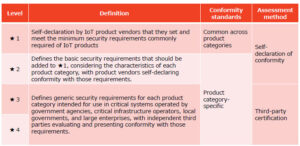
Figure 1 Definition of JC-STAR requirement levels
Source: Information published by Information-technology Promotion Agency, Japan (IPA), compiled by RTS Corporation
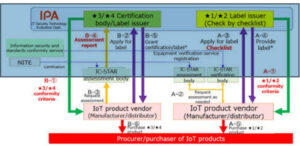
* IPA (Information-technology Promotion Agency) reviews applications for label acquisition by consulting relevant government agencies, including Ministry of Economy, Trade and Industry, regarding supply chain risks prior to label issuance, and issues the label based on the results of that consultation.
Figure 2 Scheme of JC-STAR
Source: Website of Information-technology Promotion Agency, Japan (IPA)
https://www.ipa.go.jp/en/security/jc-star/index.html (in English) https://www.ipa.go.jp/security/jc-star/index.html (in Japanese)