
Japan Solar Update: No.221 (Oct 5 ~ 12, 2026)
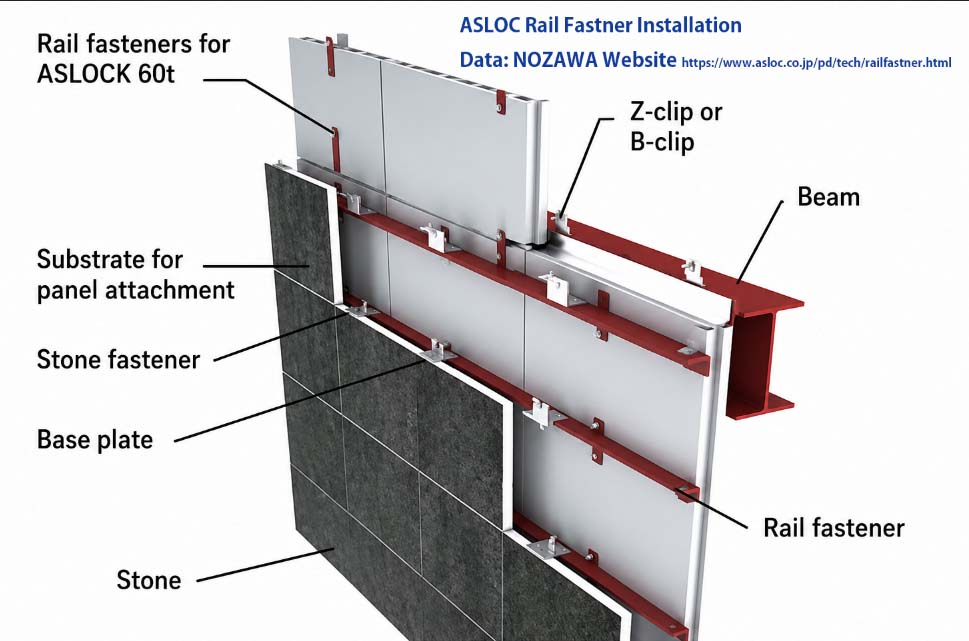
Photovoltaic has traditionally been installed on rooftops and open land. As suitable installation space becomes increasingly limited, particularly in urban areas, building facades are attracting attention as another potential surface for solar generation. A new installation method developed by NOZAWA, AGC, and AGC Glass Kenzai offers an interesting example.
The “ASLOC Rail Fastener Solar Panel Installation Method,” which began full-scale sales in Japan in July 2026, enables PV panels to be installed vertically on the exterior walls of steel-framed buildings.
The system combines NOZAWA’s Rail Fastener technology with AGC Group’s “SUNBRICK” installation solution. Dedicated fasteners allow PV panels to be attached to ASLOC exterior wall panels without requiring a large steel support structure. This makes it possible to use the building facade itself as a power-generating surface.
One of the most important aspects of the system is how it responds to earthquakes. In a steel-framed building, an earthquake can cause horizontal movement between floors, known as interstory drift. If a rigidly fixed PV system cannot accommodate this movement, significant forces can be transferred to the wall, mounting hardware, or PV panels. The Rail Fastener system is designed to allow this movement. During an earthquake, the ASLOC panels can move through a rocking mechanism, while the connection points of the rail fasteners rotate to follow the movement of the building. In other words, the system is designed to move with the building rather than simply resisting the movement as a rigid structure. This is particularly important for facade-mounted PV because the panels become part of the building exterior. Maintaining the relationship between the PV panels, the wall panels, and the building structure during seismic movement is essential not only for structural safety but also for preventing damage or detachment of the PV system.
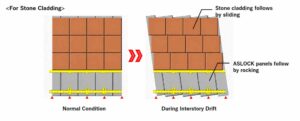
Reliable seismic performance:
ASLOC panels accommodate inter-story drift caused by earthquakes through a “rocking” action, while rail fasteners respond via the rotation of the base plate connection points. Additionally, specialized installation methods allow for compatibility with various finishing materials.
Source: NOZAWA Corporation Website Page (Japanese)
The approach has been tested for earthquake and wind safety, and the dry installation method also allows PV panels to be replaced or upgraded in the future. From a PV market perspective, the significance of this technology goes beyond a new mounting method. It represents a building-integrated approach in which the building facade itself becomes part of the solar generation system.