
The usefulness of PPA
Around 2021, when FIT purchase prices and spot prices in the electricity market reversed, the introduction of PV systems independent of the FIT and FIP programs began. One of the mechanisms supporting this trend was the PPA (Power Purchase Agreement) scheme. Under the scheme, power producers and consumers sign longterm contracts, trading electricity and environmental value at predetermined prices (yen/kWh) during the contract period.
Power producers can secure long-term and stable profits while minimizing market price fluctuation risks, making it easier to forecast future cash flows and raise funds. Meanwhile, consumers can secure electricity derived from renewable energy and environmental value without bearing the burden of initial investment or the operation and maintenance (O&M) of power generation facilities. Furthermore, since the procurement price of electricity is fixed, it is possible to avoid risks of future price increases or price surges during emergencies
In this way, PPAs bring economic benefits to both power producers and consumers, while also broadening the criteria for PV introduction from yen/kW to yen/kWh, lowering the barriers to introduction. The expansion of PPAs can play a role in shifting PV from a power source dependent on policy support to one that can be deployed independently based on contracts with consumers.
New PPA moves
The introduction of PV systems through PPAs initially began with on-site PPAs under which PV systems are installed directly at demand sites, then progressed to off-site PPAs connecting power plants and demand sites via the power grid, and virtual PPAs that focus solely on environmental value. Since the PV introduction via the PPA scheme is based on a bilateral power supply transaction with PPA operators, it has not been familiar to PV power generation until now. PPA operators face risks of recovering their initial investment through long-term fee revenue, and electricity consumers are concerned about new contract forms, reflecting concerns from both sides. However, with the Ministry of the Environment (MoE) supporting the PPA scheme, understanding of its benefits and risks gradually expanded, and the accumulation of one-off installations began to lead to continuous installations. Today, as shown in Table 1, initiatives with high potential to support selfsustaining PV introduction such as “power consumer-led introduction,” “PPA operator-led introduction,” and “utilization of PPA in promising new markets” are beginning, and in addition to aggregated, collective, and systematic introductions, the sophistication of PPA utilization is also being pursued.
In ‘power consumer-led introduction,’ municipalities with multiple facilities, schools, private companies, and public infrastructure with high electricity demand are actively aiming for signing PPA contracts as major consumers, aiming to convert their electricity to green power and reduce costs through self-consumption. Municipalities, companies with multi-store operations such as convenience stores, supermarkets, and shopping malls, as well as companies with multiple factories or business sites, receive power supply via on-site PPAs to their owned facilities and supplement shortfalls with off-site PPAs or virtual PPAs. Railway companies with many facilities secure renewable energy power by signing off-site PPAs not only for railway operations, but also for stations, adjacent facilities, and airport facilities.
operators combine multiple facilities or utilize their own surplus electricity to meet the electricity needs of consumers, among other efforts. The “Corporate Partnership PPA” scheme is also expanding, where electricity retailers aggregate multiple PV power plants developed by EPCs for consumers seeking green power to establish a stable power supply system. Companies with advanced forecasting and aggregation technologies acquire customers through schemes that increase renewable energy ratios by supplying “renewable energy composite PPAs” that combine several types of renewable energy power plants and “PV PPAs co-located with battery storage” that supply power closer to the demand curve of consumers.
Furthermore, the use of PPAs for new markets, which is expected to expand in the future, has also begun to progress. Off-site and virtual PPAs are increasingly being utilized for agrivoltaics and floating PV power generation to contribute to agricultural development and reservoir maintenance.
Contribution to the Seventh Strategic Energy Plan
The expansion of PPA models will not only improve profitability and economic efficiency for power producers and consumers, but also greatly contribute to the self-sustainability of PV power generation through the expansion of PV installations, the integration of electricity into the market, the securing of balancing capacity, and the stabilization of the power supply, as envisioned in the Seventh Strategic Energy Plan. Currently, most PPAs are being used between large corporations or local governments without creditworthiness issues, and although they are developing, their use remains limited. The government should not only provide policy support to complement creditworthiness and safety, but also promote the use of PPAs tailored to the market, allowing electricity consumers ‐ from large corporations to small and medium-sized enterprises and individuals – to use them with peace of mind. PPAs have the potential to become a major driving force replacing the FIT program and let us use the PPA scheme as a catalyst for the selfsustaining growth of PV power generation.
Table 1 The growing use of PPA scheme to drive the growth of PV deployment
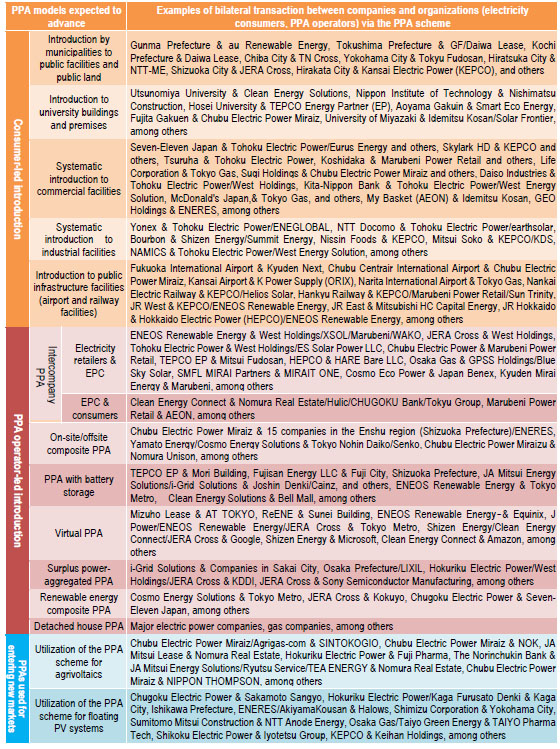
Table 1 The growing use of PPA scheme to drive the growth of PV deployment
©RTS Corporation