
Renewable energy should be switched to power sources with stable supply
During the first oil shock in 1973, Arab countries imposed an oil embargo, resulting in a halt of about 7% of global oil supply and a significant impact on the global economy. In the current Middle East crisis, it is analyzed that more than 20% of global oil supply has been affected, and at the time of writing, uncertainty remains regarding the recovery of supply capacity and the reopening of the Strait of Hormuz, raising concerns that the impact may be prolonged.
In this context, it is increasingly recognized that renewable energy, which has been promoted as a measure against global warming, is also contributing to energy security strategies. This is because marginal costs are extremely low, are not affected by fuel price fluctuations, and reducing fossil fuel imports can mitigate geopolitical impacts. Furthermore, PV and wind power generation, which are variable renewable energy (VRE), have been evaluated as not leading to stable supply, but when used together with storage batteries, it has been verified that they can be used as firm power generation capable of supplying electricity 24/7, 365 days a year.
Concept of Firm Power Generation
Firm Power Generation refers to the ability of a specific power source (or a combination of multiple power sources) to match supply and demand 24 hours a day continuously and stably throughout the year, with high certainty. VRE systems such as PV and wind power generation are not originally “firm” power sources because their output depends on weather conditions, and as their deployment has progressed, concerns have arisen about maintaining the reliability of the power grid. However, by combining PV systems with storage batteries, whose costs are declining, and operating appropriate technology, it has become economically possible to effectively utilize VRE as a stable power supply.
Benefits of Introducing PV + Storage Batteries
With the combination of PV systems and storage batteries (PV+BESS), it becomes possible to supply (dispatchable) and zero-emission electricity according to demand, making it possible to utilize highly variable PV as a reliable resource like a “baseload power source,” and as will be discussed later, the benefits of its deployment are significant.
● Cost competitiveness: In a report by the International Renewable Energy Agency (IRENA) published in May 2026, “24/7 Renewables: The Economics of Firm Solar and Wind”, the firm levelized cost of electricity (F-LCOE) for PV+BESS systems has decreased, reaching a level where it can sufficiently compete with new natural gas-fired power plants in many regions, and it is analyzed that F-LCOE of PV+BESS will continue to decline.
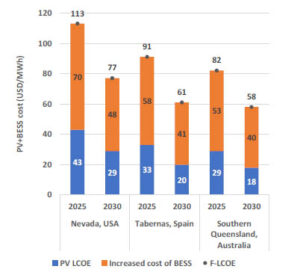
Figure 1 F-LCOE of PV+BESS as of 2025 and outlook for 2030
Source: IRENA “24/7 Renewables: The Economics of Firm Solar and Wind” (May 2026)
@RTS Corporation
For example, in Spain, electricity rates for large consumers are $ 160 – 180 /MWh, whereas the F-LCOE as of 2025, is lower at $ 91 /MWh. Looking ahead, as shown in Figure 2, as the initial investment costs for installing storage batteries and PV systems decrease, it is certain that PV+BESS will gain cost competitiveness.
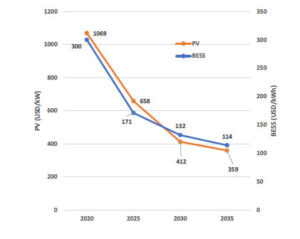
Figure 2 Global trends and outlook of initial investment costs for PV+BESS
Source: IRENA “24/7 Renewables: The Economics of Firm Solar and Wind” (May 2026)
● Avoidance of price fluctuations: By utilizing solar energy, which has almost zero marginal cost, there is no impact of the risk of fuel supply interruptions or fuel price fluctuations, which is why renewable energy+BESS is beginning to be adopted in corporate PPAs.
● Lead time for installation: PV+BESS uses modular components and can be built within a few months to one year. In contrast, gas-fired, coal-fired, and nuclear power plants require several years to 10 years or more to build each plant. Therefore, combining PV with storage batteries is the fastest way to operate new power generation facilities, and it has begun to be introduced as a power source for data centers.
● Grid resilience: PV+BESS functions as a regional backup power source, helping to regulate demand during peak times and prevent power outages.
Challenges for the deployment of PV+BESS
Stable supply through PV+BESS worldwide is expected to significantly change the power supply structure going forward, while there are also challenges. To maximize the utilization of PV and BESS and secure revenue, advanced operations – including highly accurate power generation forecasting – are required to respond to weather risks and output curtailment. As shown in Figure 2 above, the installation cost of storage batteries is expected to decrease, but it is necessary to build a revenue model assuming that PV modules require replacement after ten years or so, whereas the lifespan of PV modules is 25 – 30 years. Globally, as there is a growing need to adopt products manufactured in demand regions to address cybersecurity, this is expected to impact cost increases. Furthermore, as dependence on lithium-ion batteries increases, it becomes more susceptible to fluctuations in global supply chains, making it necessary to evaluate alternative technologies such as flow batteries and Na-ion batteries.
For ensuring energy security with renewable energy
As mentioned above, globally, efforts are underway to strengthen the security of renewable energy and energy storage that are evolving themselves as Firm Power Generation. In Japan as well, the grid-scale storage battery projects have recently become more active, and by 2040, we must promote the expansion of Firm Power Generation that combines PV, which will be the top source in the power generation mix, and BESS. Going forward, from the perspective of energy security, it will be necessary to continuously and specifically formulate a “PV+BESS Introduction Acceleration Plan (Roadmap)” and advance institutional design and market formation to expand Firm Power Generation utilizing PV power.