
Global cumulative PV installed capacity reaches 3 TW
According to the “Snapshot of Global PV Markets 2026” published by the International Energy Agency’s Photovoltaic Power Systems Programme (IEA PVPS), global cumulative PV installed capacity stood at 2,973 GWdc as of the end of 2025. With over 70 GWdc installed in the first quarter of 2026, it is certain that cumulative installed capacity has exceeded 3 TW by the end of April 2026. Cumulative installed capacity has tripled in just three years since surpassing the 1 TW mark in 2022.
PV Emerges as the Largest Source of Growth
With its rapid expansion in deployment, PV power generation has become a key source of energy supply as well. In the “Global Energy Review 2026” published by the International Energy Agency (IEA) on April 20, 2026, PV is identified as the “largest source of growth,” accounting for 27% of the increase in energy demand in 2025 – the highest share among all generation technologies. When other renewable energy technologies are included, this marks the first time in history that renewables have accounted for the largest share of the increase in global energy demand. The report also noted that the growth rate of global electricity demand – at approximately 3% – is more than double that of overall energy demand, indicating that the world has entered the “Age of Electricity.” Global total electricity generation in 2025 increased by 850 TWh from the previous year, with PV power accounting for 70% (600 TWh ) of this increase. IEA Executive Director Fatih Birol stated: “Electricity consumption is growing much faster than overall energy demand , and one energy source, PV, is growing much faster than any other. PV accounts for over a quarter of all of the world’s energy demand growth – more than any other source, for the first time. In today’s rapidly shifting landscape, countries that prioritize resilience and diversification will be best placed to deliver secure and affordable energy.”
PV Power Generation Contributes to Energy Security
The above remarks were made with the military conflict in the Middle East in mind. At the time of writing, the situation surrounding the blockade of the Strait of Hormuz and the prospects for the recovery of fossil fuel-related facilities damaged in attacks in Middle Eastern countries remain unclear. Although the level of impact varies, all countries are facing the threat of tightening fossil fuel markets and rising costs due to geopolitical risks. Amid these circumstances, PV is expected to play a major role as a power source that enhances energy security. In its “Energy Technology Perspectives 2024,” the IEA provides a comparative analysis of PV and fossil fuels, as shown in Figure 1. According to the IEA, A single journey by 1 large container ship of solar PV modules can provide the means to generate as much electricity as the gas on over 50 large LNG tankers or the coal on over 100 large ships.
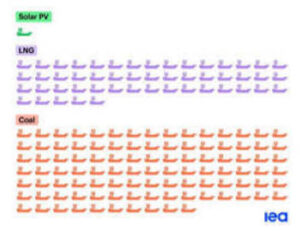
Figure1 Comparison of fossil fuels and PV modules from a transportation perspective Source: IEA Energy Technology Perspectives 2024 (https://x.com/IEA/status/1853845992098947235/photo/1)
Initiatives to Promote Renewables Reinforced in Response to the Middle East Crisis
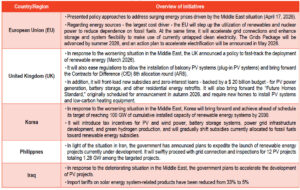
The United Nations has strongly called for a transition to renewable energy, arguing that the Middle East crisis has exposed the fundamental vulnerabilities at the core of the world’s energy challenges. In response to this movement, initiatives to accelerate the deployment of renewable energyincluding PV power – have been announced in the European Union (EU), the United Kingdom (UK), and other countries. This reflects growing recognition that renewables contribute not only to decarbonization, but also to energy security. Table 1 presents examples of initiatives in various countries to accelerate the PV deployment in response to the Middle East crisis.
Table 1 Examples of initiatives to accelerate the PV deployment in response to the Middle East crisis
@RTS Corporation
For Strengthening Japan’s Energy Security
In Japan, the Seventh Strategic Energy Plan positions PV as the leading power source as of 2040 in terms of both installed capacity and electricity generation. In this respect, it aligns with the IEA’s view that “solar becomes the new king of electricity.” However, given Japan’s high dependence on fossil fuels from the Middle East and its exposure to geopolitical risks, Japan should accelerate the PV deployment without waiting until 2040 and bring forward the achievement of its targets. Expanding PV power – whose marginal cost of generation is virtually zero – will make it possible to build a resilient society that is less vulnerable to future energy price spikes and geopolitical risks. In parallel with the expansion of PV deployment, Japan should also promote the introduction of battery storage, enhance demand response, implement inverters equipped with grid-support functions, and rebuild the supply chain for solar cell and module procurement, thereby further strengthening energy security through PV deployment.