
Desirable Agri-PV power generation
The Ministry of Agriculture, Forestry and Fisheries (MAFF) has been holding meetings of the Study Group on Desirable Agri-PV Power Generation since May 2025 to clarify and optimize the ideal form of agrivoltaics, or Agri-PV power generation, and at the sixth meeting in April, the policy on “desirable Agri-PV power generation” was summarized.
For future introduction of Agri-PV systems, in addition to permits for primary conversion of farmland, obtaining approval under the Act on Promoting Generation of Electricity from Renewable Energy Sources Harmonized with Sound Development of Agriculture, Forestry and Fisheries (REAFF Act) will be mandatory, and the perspective of development in harmony with local communities will now be incorporated into the system – a major difference from previous systems.
The basic principles of desirable Agri-PV power generation are as follows: it is a premise that proper farming continues and allows special temporary conversion of farmland; that the farmland’s function as a food production base is maintained into the future and contributes to ensuring food security; and that it is an initiative that contributes to increasing farmers’ income and business development. It is emphasized as an initiative that ensures harmony with local communities and contributes to regional revitalization. To achieve this, the requirements included ensuring agricultural sustainability for farmers, crops generally cultivated locally and harvestable annually, equipment with a shading rate below 30%, minimum ground height of 3 meters, and spacing of pillars 4 meters or more.
Based on these basic policies, MAFF has established legislation and operation as a new system, and has set a policy to promote Agri-PV power generation.
Increasing entry of large corporations
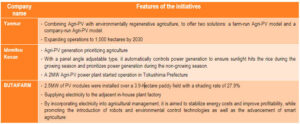
Until now, domestic Agri-PV systems have been mostly introduced by individual farmers and the systems were mostly small, but with the entry of major companies and agricultural corporations, new developments toward the expansion of Agri-PV power generation have begun from various sectors, as shown in Table 1. In addition, entry by conventional power companies, Power Producers and Suppliers (PPS), gas companies, PV manufacturers, financial institutions, real estate companies, general contractors, and others is expanding, and synergistic development is expected between agriculture utilizing PV power and power generation businesses utilizing farmland.
Table 1 Examples of new initiatives for Agri-PV power generation crisis
@RTS Corporation
Overseas developments
Meanwhile, globally, with the expansion and advancement of PV installations, recognition is growing that a new category known as agrivoltaics, or Agri-PV, is transforming farmland into a place that simultaneously produces food and energy, thereby contributing to food security, energy security, and climate change mitigation (decarbonization). By utilizing farmland simultaneously for both agricultural production and PV power generation, land use efficiency can be improved; shade from PV modules can protect crops and livestock from increasing extreme weather, enhance agricultural resilience by reducing water consumption, and, more broadly, provide habitats for plants and animals to mitigate global biodiversity loss. There is also anticipation for the expansion of attractive business models that enable the expansion of more sustainable PV power generation in collaboration with local stakeholders and the agricultural sector. According to IEA-PVPS, global Agri-PV deployment is accelerating, driven by supportive policies in pioneering countries including China, France, the United States, Italy, Israel, South Korea, and Germany. Cumulative global Agri-PV installed capacity is estimated at around 20 GW. India plans to deploy 10 GW of Agri-PV PV systems, and large-scale deployment is expected globally.
Toward the desirable development of Agri-PV In
In Japan, the Seventh Strategic Energy Plan targets the 2040 PV installed capacity at a scale of 200-280 GW in the energy mix, making the utilization of farmland essential. According to our forecast, achieving this requires the introduction of 22-49 GW of PV systems in the field of agricultural land utilization, with annual installed capacity expected to reach 2-5 GW in 2040. This will require deployment at a scale more than ten times that of the current annual installed capacity, which is estimated at around 0.3 GW.
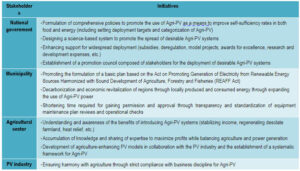
Table 2 shows the proposed initiatives of each sector to expand the deployment. The government should develop a comprehensive policy framework to promote the deployment of Agri-PV as a means of improving both food and energy self-sufficiency, including the establishment of deployment targets. In addition, a science-based regulatory framework should be designed to facilitate the wider adoption of desirable Agri-PV systems. The formulation of basic plans under the Act on Promoting Generation of Electricity from Renewable Energy Sources Harmonized with Sound Development of Agriculture, Forestry and Fisheries (REAFF Act) should be encouraged at the municipality level. Greater utilization of Agri-PV is expected to contribute to regional decarbonization and economic revitalization through locally produced and consumed energy. Greater awareness of the benefits of deployment within the Agri-PV sector is needed. The wider use of PV-powered farming practices, specialized agricultural equipment, and digital and smart farming technologies is expected to accelerate the adoption and effective utilization of Agro PV.
In the PV industry, it is necessary to strictly adhere to business discipline and balance with agriculture, reduce costs for Agri-PV power generation, and develop a business model for utilizing PV power in collaboration with the agricultural sector.
To transition to a phase that promotes the desirable introduction of Agri-PV power generation, a public-private council (tentative name) is needed to promote agriculture utilizing PV, composed of stakeholders such as relevant ministries, municipalities, agricultural organizations, agricultural machinery industries, PV industry, and academic fields such as agriculture and engineering studies, with agricultural development as a fundamental premise. Closer coordination across government ministries, industry sectors, and technical fields is required. Continued cross-sectoral dialogue will be essential to realizing both food security and energy security in Japan through the deployment of Agri-PV. Let us realize a future-oriented ‘simultaneous growth model of agriculture × energy,’ where PV drives agricultural development, and agriculture drives PV development. The PV industry side should not view Agri-PV as an extension of ground-mounted PV projects, but should pursue it as part of Japan’s agricultural development.
Table 2 Proposals for initiatives by sector to expand and establish desirable Agri-PV
@RTS Corporation